May 28, 2026 • Thiên-Anh Roussel • 8 min reading time • Prices verified June 18, 2026
Ramekins with Lids: Prep-Ahead Soufflé Bases and the Storage Question
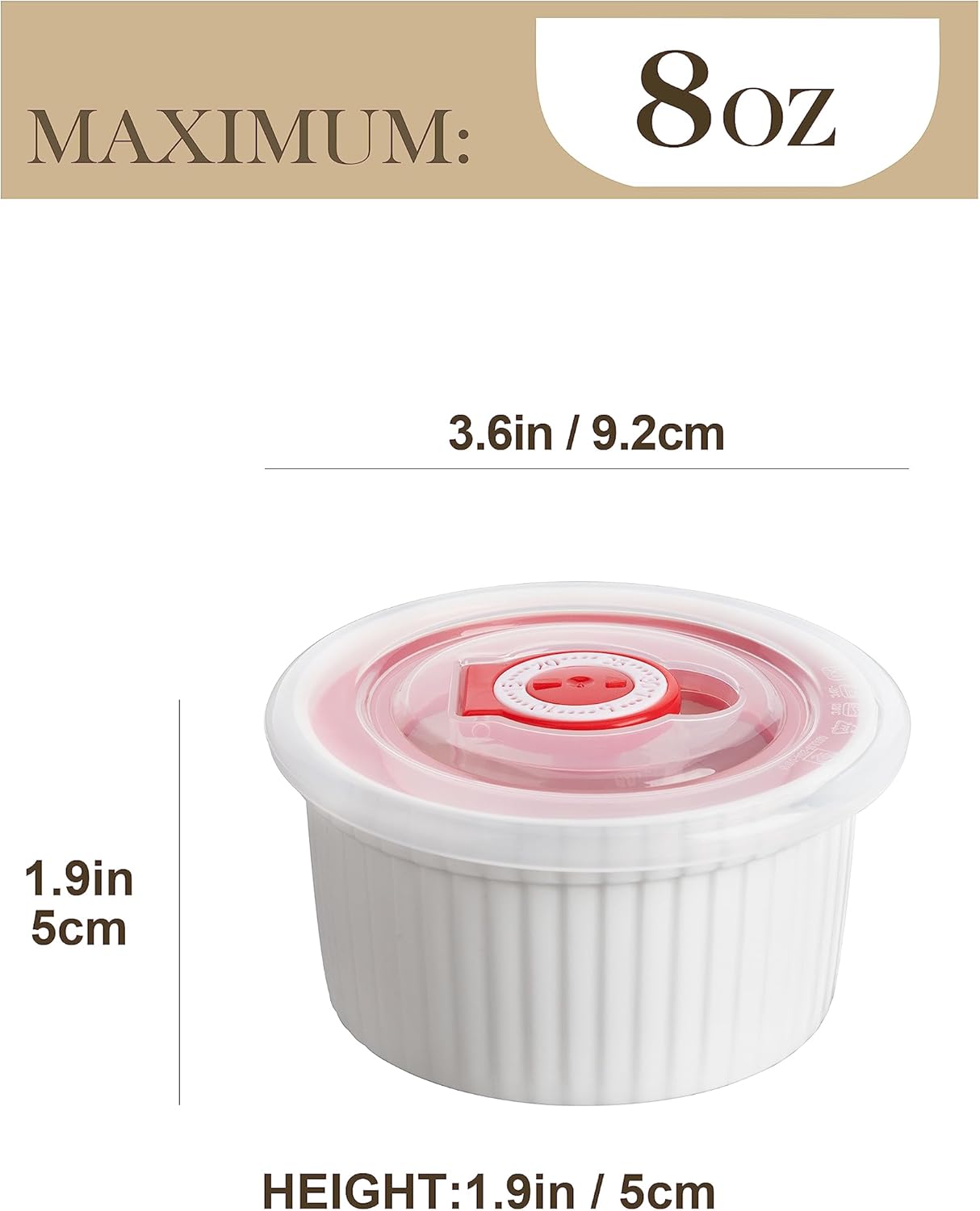
Here’s a warm welcome to anyone arriving with a dinner party on the calendar and a mild sense of dread: soufflés do not have to be an all-or-nothing gamble made at the last possible minute. A soufflé base — the thick, flavored sauce (called a béchamel or crème pâtissière, depending on whether it’s savory or sweet) that forms the structural core of the dish — can be made hours or even a day ahead. What that requires is a proper vessel with a proper lid: something airtight enough to prevent a skin from forming on the base, sturdy enough to go from refrigerator to oven without thermal shock, and well-designed enough that the walls still support an even rise when baking time comes. That’s the whole topic in miniature. This article maps the available options, names the tradeoffs clearly, and ends with a practical decision rule so you know exactly what to buy.
| EDITOR'S PICK[Kook Ceramic Mini Cocotte Set](https://www.amazon.com/dp/B083TQ8WLT?tag=greenflower20-20) | Mid-tier[DOWAN Ramekins 8 oz Oven Safe](https://www.amazon.com/dp/B08MVT52KB?tag=greenflower20-20) w… | Budget pick[MALACASA Ramekins with Lids 8 o](https://www.amazon.com/dp/B0D2VTK6Q2?tag=greenflower20-20)… | |
|---|---|---|---|
| Capacity | 12 oz | 8 oz | 8 oz |
| Qty in set | 4 | — | 6 |
| Material | Stoneware | Porcelain | Porcelain |
| Max oven temp | 350°F | — | — |
| Dishwasher safe | ✓ | — | ✓ |
| Microwave safe | ✓ | — | — |
| Price | $42.95 | $22.99 | $14.98 |
| See on Amazon → | See on Amazon → | See on Amazon → |
Why the Lid Question Actually Matters for Soufflés
Most ramekin guides treat lids as a nice-to-have — a convenience for storing leftovers or portioning crème brûlée. For soufflé work, the lid is a functional requirement, not an accessory, and the reason is chemistry.
A soufflé base left uncovered in a refrigerator develops a skin within twenty minutes. That dried surface layer doesn’t reintegrate smoothly when you fold in the whipped egg whites (the component that creates the rise). You end up with streaks of dense, un-incorporated base through the batter — and the rise is compromised unevenly. Fine Cooking’s archive on soufflé science describes this precisely: the protein structure at the surface dries and tightens, creating an obstacle to the gentle folding motion that’s supposed to preserve air bubbles.
A fitted lid eliminates this entirely. But “lidded ramekin” is not one thing — it’s a product category with real variation in how the lid fits, what it’s made of, and whether it’s oven-safe. Each of those variables interacts with the prep-ahead workflow differently.
The core decision matrix:
| Lid type | Fridge-to-oven? | Airtight seal? | Works as baking vessel? |
|---|---|---|---|
| Glazed ceramic snap-fit | Yes (if rated) | Good | Yes |
| Silicone press-fit | Yes | Excellent | Lid off before baking |
| Borosilicate glass lid | Yes | Good | Yes, with care |
| Plastic clip-top | No | Excellent | No — transfer required |
Material Tradeoffs: Porcelain, Stoneware, and the Lid Interface
The body of the ramekin matters more than the lid in one specific way: heat behavior at the wall. A soufflé rises because steam and hot air expand rapidly inside the batter, and the walls of the ramekin direct that expansion upward rather than outward. Straight walls are non-negotiable for this reason — a sloped or tapered vessel lets the batter relax outward, and the rise is flatter and less reliable. (This is covered in depth in SoufflePan’s straight-wall vs. sloped geometry guide, but the short version: straight walls are not a style preference, they’re a structural requirement.)
Porcelain conducts heat gently and evenly from the bottom and sides. Pillivuyt’s fluted soufflé dishes — widely regarded among practitioners as the benchmark in this category — have walls that heat consistently enough that base-cooking time can be predicted reliably. The glaze on quality Pillivuyt porcelain is dense and non-reactive, meaning an acidic base (a lemon soufflé, say, or a base with wine reduction) doesn’t interact with the surface over repeated use. Owners in long-run reviews consistently note that crazing (the fine surface crackle that develops in cheaper glazes over thermal cycling) is not a problem with Pillivuyt after years of regular use.
The challenge with porcelain ramekins and lids is that most porcelain ramekins — including Pillivuyt and HIC — are not sold with manufacturer-matched lids. You are sourcing the lid separately, which means fit is imprecise. The practical workaround most practitioners use is a silicone press-fit lid sized to the ramekin’s inner diameter, removed before baking. This works reliably and costs very little; the seal quality from a well-fitted silicone lid actually exceeds what you get from most ceramic snap-fits.
Stoneware — Le Creuset and Staub both produce lidded stoneware ramekin sets, and this is where the lid question becomes elegantly solved. Le Creuset’s stoneware petite ramekins (the 8-ounce and 12-ounce versions) come with fitted stoneware lids that are rated for oven use. Owners report the lids develop a light suction seal as the ramekin cools in the refrigerator, which is nearly ideal for overnight base storage. The tradeoff is mass: stoneware is denser than porcelain, and the walls heat more slowly. Cook’s Illustrated’s equipment notes flag this specifically — stoneware ramekins tend to add 2–3 minutes to soufflé bake times compared with porcelain of the same volume. That’s not a dealbreaker, but it’s a calibration your recipe needs to account for.
Copper — Mauviel’s copper soufflé molds are genuine heirlooms and the correct choice for serious oven-to-table presentation. They are not, however, the right vessel for refrigerator storage of a raw soufflé base. Copper is reactive, and even tin-lined copper should not be used to store acidic preparations for extended periods. The standard workflow for copper mold users is to prep the base in a separate container (a lidded porcelain bowl or glass storage container), then butter and flour the copper mold while the base rests, and transfer at baking time.
The Prep-Ahead Workflow, Step by Step
Understanding the workflow clarifies what the ramekin actually needs to do at each stage:
Stage 1: Base preparation. The base is cooked on the stovetop and needs to cool before egg yolks are incorporated (hot base scrambles the yolks). This stage happens in a saucepan — the ramekin isn’t involved yet.
Stage 2: Yolk incorporation and storage. The cooled base has egg yolks whisked in, the mixture is seasoned, and it’s transferred to a storage vessel. This is where the lidded ramekin enters. Food52’s soufflé Q&A guide recommends pressing plastic wrap directly onto the surface if you lack a fitted lid — but notes this is a fallback, not a preference, because imperfect wrap placement still allows some surface drying at the edges.
Stage 3: Resting. The base can rest up to 24 hours refrigerated. Beyond that, the yolk structure begins to weaken. Anything past 24 hours is a meaningful risk to rise quality; the math doesn’t favor it.
Stage 4: Tempering and folding. The base needs to come to room temperature — roughly 45–60 minutes on the counter — before egg whites are folded in. A cold base stiffens the whites on contact and deflates them. This is non-negotiable.
Stage 5: Baking. The ramekin goes directly into the preheated oven.
By the numbers:
- Optimal base rest: 2–24 hours refrigerated
- Surface skin formation if uncovered: within 20 minutes at room temperature, 45–60 minutes refrigerated
- Tempering time before folding: 45–60 minutes at room temperature
- Bake time adjustment for stoneware vs. porcelain: +2–3 minutes (per Cook’s Illustrated equipment notes)
Which Lidded Ramekin for Which Situation
This is the tradeoff summary the decision requires. Serious Eats’ ramekin review guide (Sasha Marx) makes the foundational point that the “best” ramekin is always context-dependent — volume, material, and use case interact. For the specific prep-ahead soufflé workflow, the context narrows the field considerably.
If you want a matched lid with no improvisation: Le Creuset’s stoneware ramekin sets with fitted lids are the most elegant solution available in the mainstream market. The lids are oven-safe, the set looks intentional on a dinner table, and the thermal behavior is predictable once you’ve calibrated your bake time. Expect to pay $150–$180 for a set of four with lids. The stoneware mass means more thermal stability — less risk of cracking from refrigerator-to-oven transition, which is a real failure mode with thinner ceramics cycled hard in home use.
If you already own Pillivuyt or HIC porcelain ramekins: Add silicone press-fit lids in the matching diameter. These run $8–$15 for a four-pack, create an excellent seal, and introduce no baking complications because they come off before the ramekin goes into the oven. The porcelain’s heat behavior is superior for soufflés — lighter walls, faster even heat — and you’re not re-buying a full set.
If budget is the constraint: HIC’s porcelain ramekins in the $12–$20 range are widely regarded as the correct entry-level choice for soufflé work. They have straight walls, appropriate volume (6 ounces for individual soufflés), and the glaze holds up reasonably well over time, though long-run reviewers note some crazing after two or three years of heavy thermal cycling — which Pillivuyt owners do not typically report. Pair with silicone lids.
If you’re building a prosumer kit for private-dining or small patisserie: Pillivuyt’s fluted dishes remain the industry reference for soufflé porcelain, and at $85–$120 for a set of four, the cost-per-use math is compelling over a commercial lifespan. Source silicone lids for prep-ahead storage and use the Pillivuyt directly for baking and service. The visual presentation is clean, the rise is reliable, and the glaze durability is documented in professional kitchen reviews.
The Decision Rule
If your primary goal is maximum convenience with a matched lid system and you’re comfortable with stoneware’s slightly slower heat: Le Creuset stoneware ramekins with lids.
If you already own or plan to invest in porcelain for superior rise performance, and you’re willing to manage a separate silicone lid: Pillivuyt or HIC porcelain plus silicone press-fit lids.
If you’re using copper molds for service: prep the base in a separate lidded glass or ceramic container, transfer at baking time, and don’t store the raw base in the copper.
The soufflé itself rewards this level of attention. A properly rested base, folded at room temperature into well-beaten whites, baked in a correctly heated vessel — that’s not a lucky outcome. It’s a repeatable one. The lid is just the part that makes the preparation window available to you.