April 27, 2026 • Thiên-Anh Roussel • 10 min reading time • Prices verified June 18, 2026
12 oz and Up: Large Ramekins for French Onion Soup, Pot Pies, and Generous Soufflés
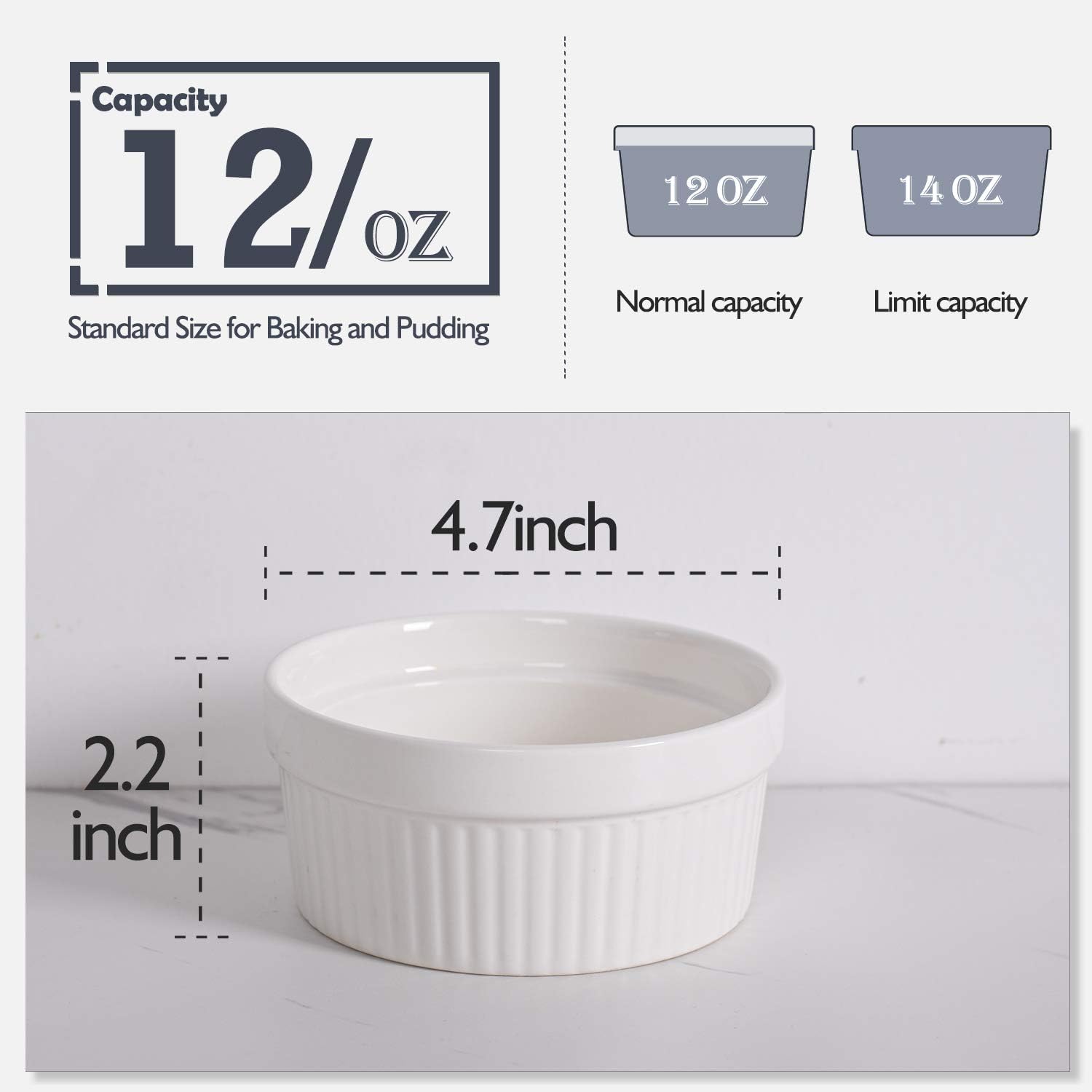
If you’ve ever ladled French onion soup into a ramekin only to realize there’s nowhere near enough room for a proper bread-and-cheese crown, you’ve already discovered why size matters in this particular piece of kitchen equipment. A ramekin — that’s simply a small, straight-sided oven-safe dish used for individual baked and served portions — sounds modest, but the difference between a 6 oz model and a 14 oz one is the difference between a polite starter and a full, satisfying main. This guide focuses specifically on large-format ramekins: dishes in the 12 oz to 18 oz range that are genuinely suited to French onion soup (where you need depth for broth, bread, and a thick gratin crust), single-serve pot pies, and generous soufflés (a baked, puffed egg-based dish that needs vertical room to rise dramatically above the rim). You’ll come away knowing exactly which size, material, and brand fit your cooking — and why those choices actually affect what comes out of the oven.
Why 12 oz Is the Practical Minimum for These Three Dishes
The standard ramekin you’ll find stacked in most home kitchens runs 6–8 oz, and it’s a fine vessel for crème brûlée or a chocolate lava cake. But French onion soup, pot pies, and oversized soufflés impose demands that smaller dishes simply cannot meet — and understanding those demands is the fastest way to stop buying the wrong size.
French onion soup requires a vessel deep enough to layer: broth, softened onions, a toasted bread round (a crouton cut to fit the diameter), and a thick blanket of Gruyère that can bubble and brown under a broiler without spilling over. Per the classic bistro standard — documented by Serious Eats in their French onion soup technique piece — the minimum practical diameter is around 4 inches, and the minimum capacity is roughly 12 oz. That gives you about 10 oz of soup and headroom for the bread-cheese layer. An 8 oz ramekin forces a compromise: either less soup or a cheese layer so close to the rim that it spills during broiling.
Individual pot pies present a slightly different geometry problem. The filling — typically 6–8 oz of braised protein and vegetables in sauce — needs a dish that allows a puff pastry or biscuit lid to sit above the fill line, forming a dome that steams and lifts rather than sitting flat and soggy. The Kitchn’s ramekin overview notes that 14–16 oz is the sweet spot for a single-serving pot pie that reads as a complete meal rather than a side dish.
Large soufflés are the most geometry-sensitive application. The classic soufflé dish is straight-walled specifically to guide the batter’s rise vertically rather than outward. A 12 oz straight-wall ramekin (approximately 4 inches in diameter and 2 inches tall) will produce a respectable individual soufflé, but practitioners who want the dramatic “hat” — the soufflé rising one to two inches above the collar — should look at 14–16 oz formats. Food52’s ramekin buying guide points out that the height-to-diameter ratio matters more than raw volume: a wide, shallow 14 oz dish performs very differently from a narrow, tall 14 oz one.
Material Matters: Porcelain vs. Stoneware vs. Enameled Cast Iron
Once you’re committed to the right size, material is the next decision with real performance consequences. This is where practitioners often over-simplify by picking aesthetics first — and then wondering why their soufflé bakes unevenly or their pot pie filling is still cold when the crust is done.
Porcelain
High-fired porcelain — the material used by Pillivuyt, HIC, and Emile Henry — is the editorial default for large ramekins, and the reasoning is straightforward. Porcelain is a dense, smooth-bodied ceramic fired at very high temperatures (typically 1260°C–1400°C), which produces a non-porous surface that resists staining, doesn’t absorb fats or aromatics, and transitions cleanly from a 500°F oven to a table setting. Cook’s Illustrated’s ramekin testing notes that porcelain heats relatively evenly and holds temperature well enough for oven-to-table service — the dish keeps contents warm during a several-minute rest between oven and first bite.
For soufflés specifically, porcelain’s moderate thermal conductivity is an advantage. It heats the batter from the sides gradually, which is what you want: a soufflé needs time for the structure to set before the surface seals. Reviewers across aggregated feedback consistently praise Pillivuyt’s 14 oz fluted ramekins for exactly this behavior — the gradual, even side-wall heat that translates to a level, tall rise.
Trade-off: porcelain can craze (develop fine surface cracks in the glaze) under repeated thermal shock — going directly from cold to a 450°F broiler, or from oven to cold water. For French onion soup where a broiler finish is standard, this matters. Emile Henry’s HR (High Resistance) porcelain, used in their soufflé dishes, is specifically engineered for thermal shock resistance, and owners report it performing well under broiler conditions over years of regular use.
Stoneware
Stoneware ramekins — including Le Creuset and Staub’s individual baking dishes — are thicker-walled, higher-mass vessels that heat more slowly but retain heat longer. For pot pies, this is genuinely useful: the dish continues conducting heat into the filling for several minutes after leaving the oven, which helps ensure the interior is fully cooked without over-browning the pastry lid. Serious Eats’ ramekin guide notes that stoneware’s thermal mass makes it particularly forgiving for filled dishes where the goal is uniform internal temperature rather than a rapid, dramatic rise.
For French onion soup, stoneware works well but requires adjusted broiler technique — the thick walls mean the broth can stay hot long enough to burn your hands through the dish after just five minutes on the table. For soufflés, stoneware’s slower heat uptake is a disadvantage: it can cause the batter’s base to lag behind the sides, producing an uneven rise or a denser bottom.
Trade-off: stoneware chips more readily at rim and foot edges than vitrified porcelain, and at 14–16 oz, stoneware ramekins can weigh 12–16 oz (350–450g) empty — significant when you’re carrying four hot dishes to a dinner table.
Enameled Cast Iron
Staub and Le Creuset both offer small individual bakers in enameled cast iron. The thermal mass here is substantially higher than stoneware, and heat distribution across the base is excellent. For braised or long-cooked pot pie fillings, the even base heat is a real advantage. Owners of Le Creuset’s individual gratin dishes report beautiful, even browning on pot pie crusts with no hotspot scorching.
For soufflés, enameled cast iron is a poor choice: the mass is too high for the rapid, even heat uptake the batter needs, and the weight (often 1.5–2 lbs per dish) makes individual service awkward. For French onion soup, cast iron’s extreme heat retention creates a scalding-dish hazard at the table.
By the Numbers: Large Ramekin Reference
| Format | Capacity | Typical Interior Diameter | Best Applications |
|---|---|---|---|
| Standard large | 10–12 oz | 3.75–4 in | Soufflés (modest), crème caramel, small gratins |
| Mid-large | 14–16 oz | 4–4.5 in | French onion soup, generous soufflés, small pot pies |
| Full individual | 18–20 oz | 4.5–5 in | Single-serve pot pies, deep gratins, shared soufflé |
Sourcing Without Regrets: What to Know Before You Buy
The large-ramekin market has a counterfeiting and gray-market problem that’s worth naming plainly. Pillivuyt, in particular, is frequently imitated: unbranded white porcelain with similar proportions sells for a fraction of the price on marketplace listings, and a small number of listings misrepresent their origin. The practical risks are non-trivial — Food52’s sourcing guide on French ceramic bakeware notes that off-brand porcelain often uses lower-firing temperatures that result in a more porous body: it stains, absorbs flavors from previous dishes, and crazes under broiler heat much faster than vitrified Pillivuyt or Emile Henry pieces.
For authorized sourcing in 2026, the clearest paths are:
- Pillivuyt: available through Williams Sonoma and Sur La Table in the US; both are authorized dealers. The Pillivuyt website maintains a dealer locator. Pricing for a set of four 14 oz fluted ramekins runs approximately $55–$75 depending on the specific series.
- Emile Henry: sold direct through the Emile Henry US site and through Williams Sonoma. Their 14 oz individual soufflé dish (the one in the HR porcelain) retails around $25–$35 per piece. Authorized dealers carry the HR line specifically; third-party marketplace listings may stock older formulations.
- Le Creuset stoneware individual bakers: widely available through the Le Creuset boutique network, Williams Sonoma, and Crate & Barrel. At $20–$30 per piece in 2026 pricing, these are honest value for pot-pie and gratin applications.
- Mauviel copper ramekins: Mauviel’s tinned-copper individual molds (200–250+ per piece) are not widely available through mass-market retailers; Mauviel’s US distribution runs through authorized specialty dealers including Williams Sonoma and select independent kitchen stores. Gray-market copper bakeware — particularly anything appearing significantly under market price — carries substantial risk of incorrect tin lining thickness, which affects both performance and food safety. The Kitchn’s sourcing notes on copper bakeware specifically flag this risk.
A practical authentication check for Pillivuyt: genuine pieces carry the Pillivuyt wordmark impressed or printed on the base alongside the “Made in France” designation. Post-2018 pieces in the current production run use a specific blue underglaze mark. If a listing shows a plain, unmarked base, treat it as unverified.
The Decision Framework: If X, Then Y
You’re here because you have a specific purchase to make. Here’s the clearest version of the decision tree based on what the research supports:
If your primary use is French onion soup and you’ll be broiling regularly: Choose a 14–16 oz porcelain ramekin in Emile Henry HR or Pillivuyt. The thermal-shock resistance of HR porcelain is specifically suited to the broiler finish, and the straight or very slightly flared wall keeps the bread round in place. Budget around $25–$35 per piece for Emile Henry, $55–$75 for a set of four Pillivuyt.
If your primary use is individual pot pies: Stoneware in the 14–18 oz range — Le Creuset or Staub — earns its weight here. The thermal mass carries heat into the filling uniformly, and the heavier dish sits stable in the oven with a pastry lid. Plan for $20–$30 per piece.
If your primary use is generous soufflés: Straight-wall porcelain is non-negotiable. The geometry matters as much as the material: measure interior diameter and wall height before buying. A 14 oz Pillivuyt fluted straight-wall ramekin (approximately 4 inches diameter, 2.25 inches interior height) is the format most consistently praised across aggregated reviews for producing a tall, even rise. Emile Henry’s individual soufflé dish is a close second and more widely available at retail.
If you’re buying for multiple applications and want one format to cover all three: A 14 oz straight-wall porcelain ramekin in Pillivuyt or Emile Henry HR is the most versatile option in the category. It is marginally large for solo soufflés, adequately sized for French onion soup, and workable for smaller pot pies. The straight wall is a soufflé-first design decision that happens to serve the other two applications well. It’s not a perfect compromise, but across the range of uses this article covers, it’s the single format most practitioners eventually land on — and the one that rewards the initial research investment.