May 8, 2026 • Thiên-Anh Roussel • 9 min reading time • Prices verified June 18, 2026
4 oz, 6 oz, or 8 oz: Picking the Right Ramekin Size for Individual Soufflés
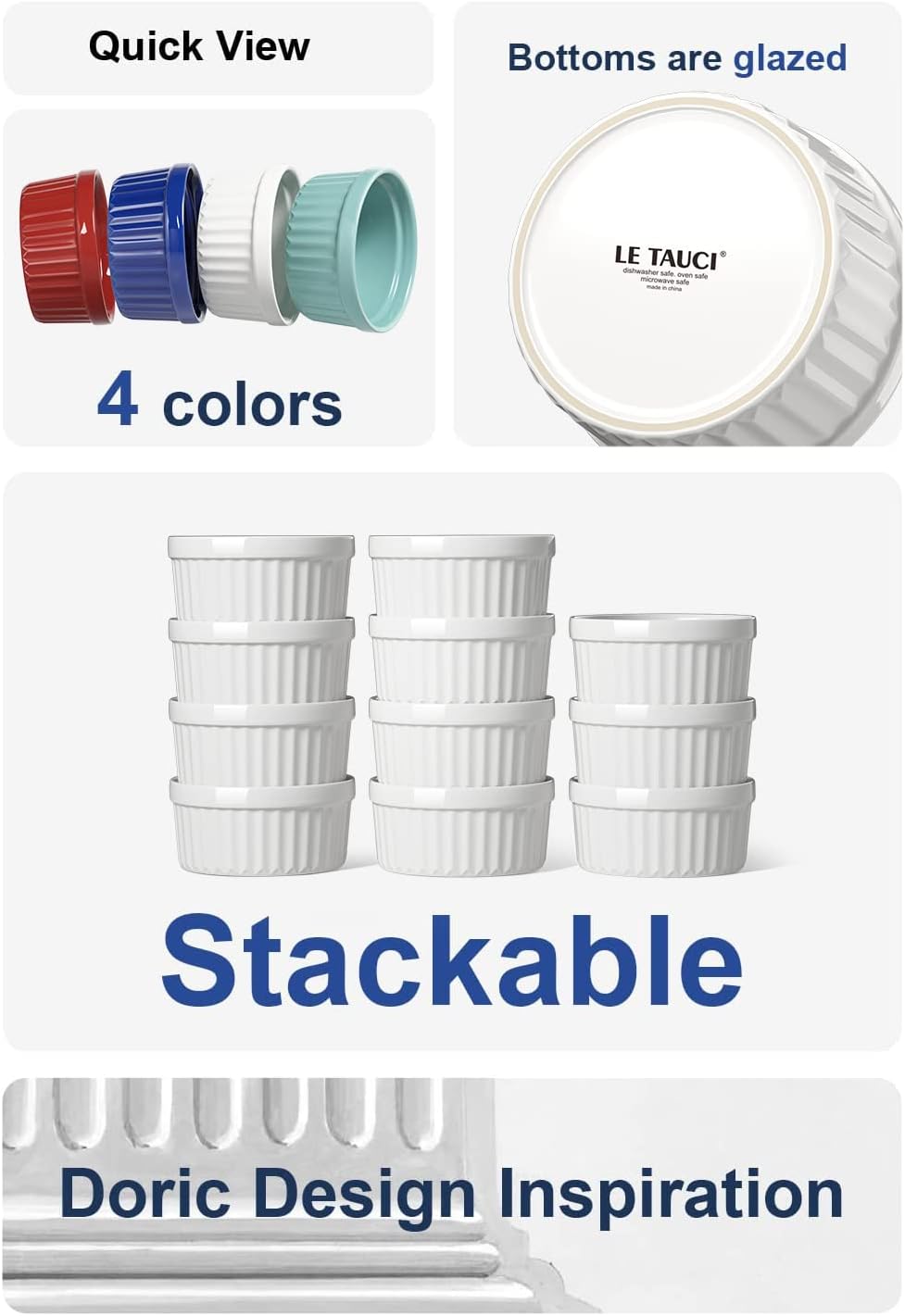
If you’ve ever set a soufflé on the table only to find it barely cleared the rim — or worse, watch it crown unevenly and slump to one side — the culprit was probably not your technique. It was likely the dish. A ramekin (a small, straight-sided ceramic cup designed for individual oven-to-table portions) controls more variables in a soufflé than most cooks realize. The volume of the vessel sets the ratio of batter to surface area; that ratio determines how fast heat reaches the center, how vigorously the steam climbs, and whether your soufflé rises with that satisfying, theatrical puff above the rim. This guide breaks down the three standard individual sizes — 4 oz, 6 oz, and 8 oz — and gives you a clear decision framework so the next time you’re standing in front of a product listing, you know exactly which one to order.
| EDITOR'S PICK[DOWAN 8 oz Ramekins Oven Safe f…](https://www.amazon.com/dp/B081N57T3D?tag=greenflower20-20) | Mid-tier[HIC Kitchen Souffle Ramekin](https://www.amazon.com/dp/B000BI8NAK?tag=greenflower20-20) | Budget pick[LE TAUCI Ramekins 4 OZ Oven Safe](https://www.amazon.com/dp/B0C5X79PTQ?tag=greenflower20-20) | |
|---|---|---|---|
| Capacity | 8 oz | 6 oz | 4 oz |
| Material | Ceramic | Fine Porcelain | Ceramic |
| Oven Safe | ✓ | — | ✓ |
| Price | $22.99 | $16.99 | $13.99 |
| See on Amazon → | See on Amazon → | See on Amazon → |
Why Size Matters More Than You Might Expect
Let’s put the physics on the table first, because this is where most buying decisions go wrong.
A soufflé rises because air beaten into the egg whites expands when heated. The batter clings to the straight walls of the ramekin as it climbs, which is why straight-wall geometry — not the flared or sloped profile you’d use for a crème brûlée — is non-negotiable for soufflé work. What the capacity number tells you is how much batter the dish holds at the fill line (typically about two-thirds full for a classic soufflé), and by extension, how thick the column of batter is from base to rim.
Thick columns heat slowly from the outside in. Thin columns heat faster, and the expansion is more uniform. This means:
- A 4 oz ramekin with a relatively thin batter column will reach the center quickly, producing a fast, dramatic rise — and a narrower window before the outside overcooks.
- A 6 oz ramekin is the most forgiving middle ground, where rise time and center doneness align comfortably at standard oven temperatures (375–400°F for most French-style soufflés).
- An 8 oz ramekin demands patience and a slightly lower oven temperature; the center needs more time, and if you rush it, you get a set exterior with a liquid core.
Serious Eats’ soufflé technique overview notes that matching dish volume to recipe yield is the single most reliable way to control rise height and texture consistency — before skill or timing even enter the equation.
The Three Sizes, Head to Head
4 oz (½ cup): The Dessert Specialist
The 4 oz ramekin is a precision instrument. Its interior diameter typically runs 3 to 3¼ inches, and the batter depth at a two-thirds fill is shallow enough that a hot oven at 400°F can heat it through in 10–13 minutes for a chocolate or Grand Marnier soufflé.
Where it excels: Rich, dense dessert soufflés — chocolate, praline, salted caramel — where you want a fully set edge and a molten or just-barely-set center. The fast heat penetration makes this possible without drying out the outer crust. It’s also the standard format for restaurant plating, where individual portions need to arrive at the table simultaneously, and a shorter bake time tightens service logistics. Culinary school curricula typically calibrate classic chocolate soufflé recipes to the 4 oz format for exactly this reason.
Where it struggles: Savory cheese soufflés and Grand Soufflé formats. A savory soufflé typically contains more bechamel (the thick white sauce that forms the base), which means the batter is denser and benefits from a longer, more gradual heat transfer. At 4 oz, the batter column is too thin; the outside sets before the base has had time to integrate, and the result is often a soufflé that rises fast, looks perfect, then collapses almost immediately when the center hasn’t fully firmed.
Fine Cooking’s equipment guide specifically flags 4 oz dishes as appropriate for “soufflés intended to be eaten in three or four bites — rich, intense flavors where restraint in portion is part of the design.”
Dish to know: HIC and Mason Cash both produce 4 oz straight-wall porcelain ramekins in the $12–$20 range for sets of four. For collectors, Pillivuyt’s 4 oz fluted ramekin in true hard-paste porcelain offers superior heat conductivity compared to softer earthenware, which reviewers consistently note affects edge browning.
6 oz (¾ cup): The All-Purpose Standard
The 6 oz ramekin — interior diameter typically 3½ to 3¾ inches — is the default choice recommended in the majority of home soufflé recipes published by Bon Appétit, Food52, and Cook’s Illustrated. There’s a reason it’s the editorial consensus: the geometry gives you room to work.
At a two-thirds fill, the batter column in a 6 oz dish is deep enough that the steam generated in the lower half of the batter helps lift the column evenly as it rises, but not so deep that the center lags catastrophically behind the exterior. For a cheese soufflé — typically baked at 375°F for 18–22 minutes — this is the sweet spot.
Where it excels: Savory applications (Gruyère, Parmesan, blue cheese), lighter fruit soufflés (raspberry, lemon), and any situation where you’re feeding guests with different eating speeds. A 6 oz soufflé holds its rise slightly longer than a 4 oz version, giving a 60–90 second window between oven and table rather than a strict 45-second sprint. Food52’s ramekin overview notes that the 6 oz format is “the size home cooks are most likely to find their recipes calibrated to, especially in French technique-focused cookbooks.”
Where it struggles: If you’re replicating a restaurant-style dessert soufflé — the kind plated in a narrow, tall format — a 6 oz dish can make the result look squat rather than theatrical. The rise-to-diameter ratio is less dramatic visually.
Dish to know: The Emile Henry Grand Cru individual soufflé dish (available in the 6 oz range, $85–$95 for a single piece) is frequently cited by home cooks building a serious batterie de cuisine. Its Burgundy clay-based stoneware retains heat longer than porcelain after removal from the oven, which marginally extends the holding window — useful at a dinner party where plating four dishes doesn’t happen simultaneously. Le Creuset and Staub stoneware sets in this size run $150–$180+ for sets of four and offer similar retention characteristics with the added visual weight of enameled interiors that present cleanly at the table.
8 oz (1 cup): The Communal Portion and the Special Case
The 8 oz ramekin occupies an interesting position. It’s genuinely useful, but it demands the most recipe adjustment of the three sizes.
By the numbers:
| Size | Typical Interior Diameter | Recommended Bake Temp | Approx. Bake Time (savory) |
|---|---|---|---|
| 4 oz | 3–3¼ in | 400°F | 10–13 min |
| 6 oz | 3½–3¾ in | 375–385°F | 18–22 min |
| 8 oz | 4–4¼ in | 365–375°F | 24–30 min |
Times are approximate and based on published recipe ranges across Cook’s Illustrated, Serious Eats, and Fine Cooking; your oven’s calibration matters.
At 8 oz, you’re essentially asking the oven to bake what amounts to a personal-scale communal soufflé. The batter column at two-thirds fill is deep, and getting heat to the center without overcooking the exterior requires dropping the oven temperature by 10–15°F relative to what you’d use for a 6 oz dish. This is not a deal-breaker — it’s just a variable you need to own consciously.
Where it excels: Twice-baked soufflés (soufflés that are baked once, deflated intentionally, then re-baked to order), savory soufflés served as a main course rather than a starter, and presentation contexts where the visual footprint matters as much as the recipe. A soufflé crowned 1½ to 2 inches above the rim of an 8 oz dish is genuinely impressive in a way that the same recipe in a 4 oz dish cannot replicate.
Where it struggles: Dessert soufflés with a molten center. The physics work against you — the long bake required to set the column means the center is likely to be more fully cooked than you want. If you’re aiming for the flowing-center effect, stay at 4 oz.
Cook’s Illustrated notes that 8 oz ramekins are “better suited to cooks who understand that the recipe is a starting point and are comfortable adjusting temperature and timing by feel.”
Making the Decision: A Clear Framework
If you’re standing in front of a buying decision right now, here’s the if-then logic that should govern it:
If your primary goal is dessert soufflés — especially chocolate, caramel, or other rich, dense formats — and you’re comfortable with a fast, precise bake window: Choose 4 oz. The portion is right, the bake time is short, and the margin for error on timing is honest about what it is: narrow but learnable.
If you want one size that works across savory and sweet applications, and you’re baking from recipes rather than developing them: Choose 6 oz. This is the size most published recipes assume. The forgiveness window is real, and the oven-to-table presentation is naturally elegant.
If you’re cooking for guests who expect a generous individual portion, doing twice-baked applications, or building a collection that covers professional-service contexts: Add 8 oz as a secondary set, not a primary one. Keep 6 oz as your default.
One practical note on material choice at any size: straight-wall geometry in true porcelain (Pillivuyt, HIC, Apilco) conducts heat more evenly than earthenware alternatives at comparable wall thickness, per published specs from those manufacturers. If you’re working at the high end of the market — Mauviel copper soufflé molds excepted, which operate on different heat transfer principles entirely — porcelain is the material the serious practitioner community consistently returns to for individual soufflé work. The glaze on quality porcelain also resists crazing (the fine network of surface cracks that develop in lower-fired ceramics over repeated thermal cycling) significantly longer, which matters when these dishes are going from a 400°F oven to a 70°F dining room three times a month.
The right ramekin won’t make a soufflé for you. But the wrong one will quietly undermine every good decision you make in the mixing bowl. Get the size right, and the technique has room to land.